Ingredient 2 of 6
Niacin and Calcium in HoneyPezil: The Vitamin and Mineral on Label A
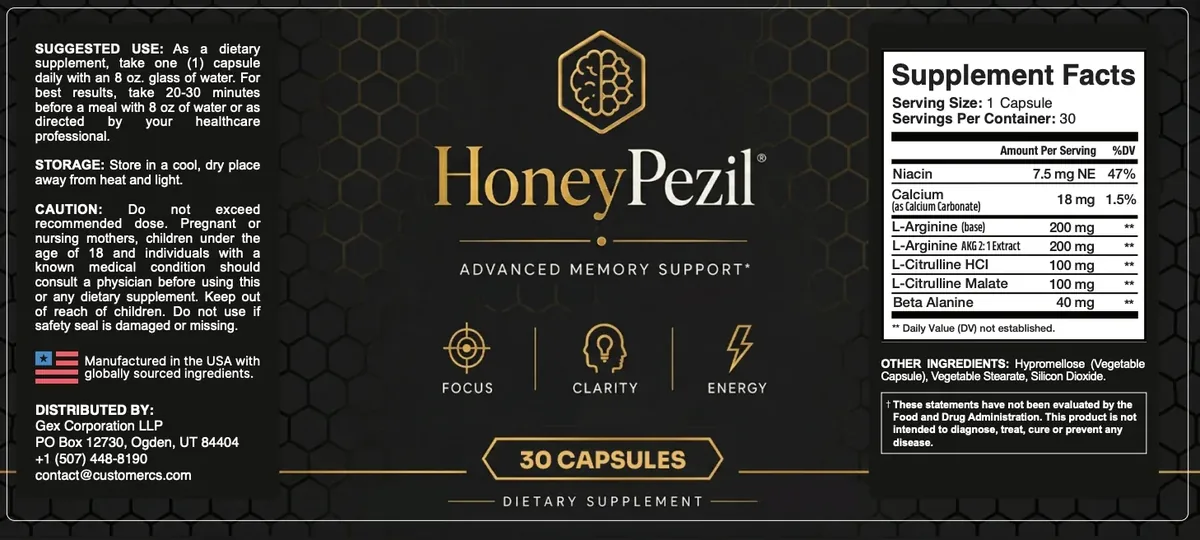
Label A of HoneyPezil prints niacin at 7.5 mg NE, which is 47% of the Daily Value, and calcium (as calcium carbonate) at 18 mg, 1.5% of the Daily Value. Both amounts sit well below NIH's upper limits. Neither is shown to help memory at these amounts.
Written by the HoneyPezil label deskUpdated
The names on the bottle01
What are niacin and calcium in HoneyPezil?
Niacin is vitamin B3 and calcium is a mineral, and Label A prints one line of each, in small amounts.
The label prints niacin as "7.5 mg NE", which means niacin equivalents. NIH explains that 1 NE is 1 mg of niacin or 60 mg of the amino acid tryptophan 1. Calcium is printed "as calcium carbonate", at 18 mg, and the percent Daily Value is 1.5%.
| Name | Panel | Printed amount |
|---|---|---|
| Niacin | Label A | 7.5 mg NE (47% DV) |
| Calcium (as calcium carbonate) | Label A | 18 mg (1.5% DV) |
Both lines appear on Label A only. Label B lists neither.
The numbers02
How do the printed niacin and calcium amounts compare with the Daily Values?
The printed niacin is 47% of the Daily Value and the printed calcium is 1.5%, so one is a meaningful share of a day's need and the other is a trace.
NIH's Office of Dietary Supplements gives the recommended daily amount of niacin as 16 mg NE for men and 14 mg NE for women, and an upper limit of 35 mg a day for supplemental niacin in adults 1. At 7.5 mg NE, the capsule is below both. For calcium, the Daily Value is 1,300 mg, the recommended amount for adults aged 19 to 50 is 1,000 mg, and upper limits are 2,500 mg (19-50) and 2,000 mg (51 and over) 2. Eighteen milligrams is a very small fraction of any of them.
| Name | Printed | Reference value | Upper limit |
|---|---|---|---|
| Niacin | 7.5 mg NE | RDA 14 to 16 mg NE | 35 mg a day, supplemental |
| Calcium | 18 mg | Daily Value 1,300 mg | 2,000 to 2,500 mg |
Memory03
Do niacin and calcium help memory?
No source we read says niacin or calcium at these amounts helps memory, because both are ordinary nutrients with ordinary jobs.
Niacin helps cells make energy, and calcium supports bone and nerve and muscle signals. A person who gets enough of each from food does not need more for those jobs. A person who is short of either should talk to a doctor, since a shortage has its own causes and fixes. We found no trial linking these two lines in a capsule like this to better recall, and the sales page cites none 3.
If you already take a multivitamin or a calcium tablet, add up the niacin and calcium. NIH's limits apply to the total, not to one product.
From food04
Where do you already get niacin and calcium?
Most adults already get niacin and calcium from food, so a capsule that adds 7.5 mg NE and 18 mg changes little for someone who eats a mixed diet.
Niacin is found in meat, fish, peanuts and fortified cereals, and the body also makes some from tryptophan. Calcium comes mostly from dairy foods, fortified drinks and some leafy greens 2. Because the capsule's calcium is a trace, it cannot stand in for those foods, and it should not be treated as a calcium supplement.
- Niacin: add up your multivitamin, your cereal and your capsule before comparing with the 35 mg limit.
- Calcium: if your doctor has told you to take calcium, this capsule does not count toward it.
- If you are worried about either nutrient, ask a doctor about a blood test or a food plan.
The point of a nutrient line on a memory capsule is easy to misread. A vitamin on a label can make a product look more "complete", but a complete-looking label is not a result. Read the number, compare it with the reference value, and move on.

HoneyPezil: from $49 a bottle30 capsules · 2, 3 or 6 bottles · free US shipping on 3 and 6 · 60-day money-back guarantee
See packsReading the label05
Why does the label print percent Daily Value for these two?
The label prints a percent Daily Value for niacin and calcium because both have an official Daily Value, while the amino acid lines do not.
The note on the panel reads "Daily Value not established" for the other names. That is why only two lines carry a percent. The Daily Value is a reference number used on labels so that people can compare products; it is not a target for everyone and not a safe-dose promise. NIH explains that the Daily Value for calcium is 1,300 mg 2, and that niacin's Daily Value is set in niacin equivalents 1.
A line with a percent is easy to trust, because a percent looks like a measurement. But 47% of a niacin Daily Value is still just a share of a day's vitamin, and 1.5% of calcium is still a trace. Neither says anything about memory. If you want to know whether you are short of either, a doctor can check, and food is the first place to look.
A percent Daily Value tells you how much of a reference amount is in the capsule. It never tells you what the capsule does.
Care first06
Who should check with a doctor about niacin and calcium?
Anyone who takes other niacin or calcium products, has kidney stones or kidney disease, or takes medicine that interacts with minerals should ask a doctor or pharmacist first.
NIH notes that calcium carbonate absorbs best with food, and that absorption varies with other medicines 2. The label's own line says to take the capsule 20-30 minutes before a meal, which is not the same as taking it with food, but at 18 mg that matters little. Keep taking prescribed medicine. If you feel flushed, itchy or unwell after a capsule, stop and call your doctor. Sudden confusion or weakness is a 911 call.
Read the side effects page for the table by name. If you are a caregiver, take the bottle and the photo of its panel to the pharmacy yourself, so the pharmacist can read the real names instead of a description. Ask the pharmacist to write the names down for your records, and ask whether any of them should be avoided with the person's other medicines. A few minutes at the counter is worth more than an hour online.
FAQ07
Niacin and calcium questions
What does 7.5 mg NE mean on HoneyPezil?
NE means niacin equivalents. NIH says 1 NE is 1 mg niacin or 60 mg of tryptophan. The capsule prints 7.5 mg NE.
Is 18 mg of calcium a lot?
No. It is 1.5% of the 1,300 mg Daily Value, a small amount.
Is the niacin in HoneyPezil too high?
It is below the 35 mg upper limit for supplemental niacin, but add other products you take.
Does niacin cause flushing?
Higher supplemental doses can. NIH describes flushing at larger amounts; 7.5 mg NE is far lower, but individual response varies.
Are niacin and calcium on Label B?
No. They are on Label A only.
Does calcium carbonate need food?
NIH says it absorbs best with food, but at 18 mg the effect is small.
Who wrote this08
Written and reviewed by
Pages built from the label, the sales page and linked NIH, FDA, CDC, FTC and peer-reviewed sources.
Last updated . Read our editorial standards and how we check reviews. This website is the information site for a USA Authorized HoneyPezil Retailer. It is not the manufacturer or the distributor named on the label. We earn money when you buy through our order links.
Keep reading
More about HoneyPezil

USA Authorized HoneyPezil Retailer
Ready to try HoneyPezil?
Read your own bottle's panel and check your medicines first, then pick a pack. Six bottles cost the least per bottle; three and six ship free in the US; every pack carries the 60-day money-back guarantee.
- Secure checkout on the sales site
- 60-day money-back guarantee
- Ships from the U.S.